
The Forgotten Story Behind the Original Ford GT40
إعلانات
فورد جي تي 40 is the legendary machine that forever altered the trajectory of international endurance racing, born from a bruised ego and an unyielding desire for vengeance.
Few vehicles command the same reverence in automotive circles, representing a pivotal moment where American raw power met European engineering sophistication in a desperate, expensive, and ultimately glorious quest for victory at Le Mans.
The saga of this iconic racer is not merely a tale of gears and gasoline, but a narrative of corporate warfare, visionary ambition, and the relentless pursuit of perfection against insurmountable odds.
Quick Navigation
- The Origins of the Rivalry
- Engineering the Impossible Machine
- Legacy and Modern Impact
Why did the Ford GT40 become a legend?
إعلانات
The genesis of the project trace back to the early 1960s when Henry Ford II attempted to purchase Ferrari after Enzo Ferrari backed out of a deal.
Furious at the humiliation, Ford ordered his engineers to build a car capable of beating the Italian masters on the most prestigious stage, the 24 Hours of Le Mans.
This ambition birthed the فورد جي تي 40, a low-slung, mid-engined prototype designed specifically to endure the grueling demands of long-distance racing.
It was a radical departure from the front-engine sports cars common at the time, utilizing a monocoque chassis that prioritized aerodynamic efficiency and weight distribution above all else.
Early iterations suffered from catastrophic stability issues, with drivers famously reporting the car becoming dangerously light at high speeds on the Mulsanne Straight.
Engineers eventually resolved these aerodynamic flaws through intensive wind tunnel testing, adding spoilers and modifying the nose to ensure the car remained planted at speeds exceeding 200 mph.

What defined its performance?
The vehicle utilized a massive Ford V8 engine, balancing brute American displacement with the agility required for intricate European road courses.
This hybrid philosophy proved successful, though reliability remained a persistent thorn in the side of the program during the initial development cycles in 1964 and 1965.
The team faced immense pressure to deliver, as the budget ballooned into the millions, representing a staggering investment for the mid-1960s era of automotive manufacturing.
Drivers like Ken Miles played a critical role in refining the handling, pushing the prototype to its absolute mechanical limits during exhaustive testing sessions at circuits across the United States.
Success did not arrive immediately, as initial attempts were marred by engine failures and gearbox malfunctions that frustrated the corporate brass back in Dearborn.
Only through the persistent efforts of Carroll Shelby and his dedicated crew did the machine transform from a temperamental prototype into a world-beating endurance champion.
++ لماذا أصبحت تويوتا سوبرا أسطورة مرة أخرى في عام 2026
How did it conquer Le Mans?
The culmination of the project occurred in 1966, when the فورد جي تي 40 secured a historic 1-2-3 finish, effectively ending Ferrari’s dominance at the event.
This victory was not just a win for a brand; it was a watershed moment that validated the efficacy of high-performance American engineering on the global stage.
Victory required more than just engine power; it demanded extreme fuel management, tire longevity, and the ability of drivers to maintain focus over twenty-four hours of constant competition.
The strategic orchestration of the final laps, immortalized in history, showcased the sheer dominance the team had achieved through two years of agonizing development.
The impact of this triumph reverberated through the industry, forcing competitors to rethink their approach to vehicle development, aerodynamics, and team management during endurance events.
It remains a benchmark for how industrial resources, when focused with laser precision, can achieve seemingly impossible goals in the realm of high-stakes motorsport.
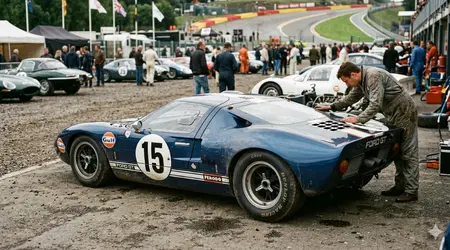
How was the engineering behind the Ford GT40 revolutionary?
The construction process relied on advanced aerospace materials and techniques, which were significantly ahead of typical automotive manufacturing standards during that specific decade of development.
The chassis, a steel monocoque, provided the necessary stiffness to handle immense torsional forces, ensuring the suspension could do its job precisely.
Engineers utilized a dry-sump oiling system to allow the massive V8 to sit lower in the frame, keeping the center of gravity impressively near the pavement.
This technical decision directly influenced the car’s legendary cornering capability, allowing it to maintain high speeds through tight bends where competitors struggled with balance.
Furthermore, the transmission choice was critical, as the ZF gearbox used in early models had to be swapped for a stronger unit capable of enduring the immense torque.
This constant iteration loop failing on the track, analyzing the wreckage, and refining the component defined the rapid, aggressive development cycle that characterized the entire racing program.
اقرأ أيضاً: قصة "سيارة البابا": كيف تطورت سيارات الفاتيكان
Which technical specifications mattered?
Performance was dictated by the engine’s ability to operate at peak efficiency for hours on end, requiring complex cooling systems that were often custom-fabricated.
The integration of ventilated disc brakes was also a game-changer, allowing drivers to shed massive speed rapidly before entering the technical corners of the circuit.
Aerodynamics played a subtle yet vital role, with the body shape intentionally designed to maximize downforce without creating excessive drag at top speed.
It is often argued that the car was a “brute in a tuxedo,” possessing the raw power of a dragster but the refined handling of a surgical instrument.
| ميزة | Specification Details |
| نوع المحرك | 7.0L Ford FE V8 |
| السرعة القصوى | Approx. 210 mph |
| Chassis | هيكل أحادي فولاذي |
| الوزن الصافي | ~2,100 lbs |
| 1966 Victory | 1st, 2nd, and 3rd Place |
Why did the driver’s role change?
ال فورد جي تي 40 demanded a new type of driver someone who could act as a test pilot, providing nuanced feedback to engineers about suspension geometry and handling characteristics.
This shift in the relationship between man and machine accelerated the evolution of racing, turning drivers into integral components of the R&D cycle.
Unlike modern systems where telemetry provides instant data, these pilots had to rely on their intuition, sensory input, and communication skills to diagnose issues.
The fatigue was immense, yet the reward was the opportunity to pilot a machine that was clearly superior to anything else on the grid at that time.
The legacy of these drivers, such as Bruce McLaren and Chris Amon, remains deeply intertwined with the car’s identity, as their bravery bridged the gap between engineering theory and track-day reality.
They were essentially taming a wild, high-horsepower beast that had little patience for amateur mistakes, especially during the rain-soaked night stints.
اقرأ المزيد: لماذا كانت سيارة جاي لينو المفضلة تعمل بالبخار؟
Is the legacy of the Ford GT40 still relevant in 2026?
Modern automotive design continues to reference the silhouette and philosophy of this car, particularly in the realm of hypercar development and high-performance electric vehicle tuning.
It serves as a permanent reminder that true innovation often stems from a combination of bold, audacious goals and rigorous, iterative engineering processes.
The market value of original chassis has skyrocketed, making them some of the most sought-after collector items in the world, with auction prices regularly exceeding tens of millions.
These cars are no longer just machines; they are historical artifacts that tell the story of a specific, pivotal era in the evolution of transport.
Is it possible that any future vehicle will capture the collective imagination of the public in the same way this machine did sixty years ago?
The answer remains elusive, as modern technology often removes the raw, visceral experience that defined the golden age of racing, yet the aspiration remains the same.
How does it influence modern design?
Contemporary designers frequently study the proportions of the original, noting how the low-profile stance and wide track continue to dictate “aggressive” aesthetic standards today.
While safety regulations have changed the physical construction of cars, the core visual language remains a touchstone for designers seeking to convey speed and power.
Engineers also look to the past to understand how weight reduction and structural rigidity were managed without the aid of modern carbon fiber composites.
The “less is more” philosophy utilized in the 1960s continues to influence how engineers approach the packaging of high-performance components in compact, mid-engined layouts.
Finally, the spirit of the project the “win at all costs” mentality continues to drive factory racing efforts today, from F1 to the WEC.
It proved that a major manufacturer could pivot from mass-market production to the pinnacle of elite sport, provided they were willing to commit the necessary resources.
What is the lasting market impact?
ال فورد جي تي 40 created a blueprint for the “halo car,” a vehicle designed not for mass sales, but to define the identity and technical capability of an entire brand.
Today, every major manufacturer has a spiritual successor that seeks to capture that same lightning in a bottle, proving the endurance of the initial concept.
In a 2026 report, automotive historians noted that the vehicle’s provenance is one of the most reliable indicators of value in the high-end classic car market.
The scarcity of original, surviving examples, combined with their verified racing history, ensures they will remain the crown jewel of any serious private or museum collection.
Think of the car as a high-performance analog clock: while newer digital options might be more accurate or efficient, the mechanical soul of the original remains the standard by which all others are measured.
As we look ahead, the legend only grows, cementing its place in the pantheon of history.
خاتمة
قصة فورد جي تي 40 is a testament to the power of human ingenuity when pushed to the absolute breaking point by corporate rivalry and personal ambition.
It transformed from a series of failures into a symbol of total domination, proving that with enough data, talent, and resources, any engineering challenge is conquerable.
Whether analyzed through the lens of history, engineering, or pure marketing, the machine remains a landmark achievement that continues to influence the world of performance motoring today.
As enthusiasts, we celebrate not just the speed of the car, but the spirit of the people who dared to challenge the status quo.
What aspect of this legendary machine do you find most impressive: the engineering precision, the driving heroics, or the corporate ambition behind the scenes? Please share your thoughts and experiences in the comments section below.
الأسئلة الشائعة
How many units were produced?
There were approximately 105 total units produced between 1964 and 1969, including street and racing variants.
Why is it called the GT40?
The “GT” stands for Grand Touring, and the “40” represents the car’s height of 40 inches from the ground to the roof.
Was the car successful immediately?
No, the program struggled significantly with reliability and handling issues during its first two years before achieving major success.
Can I buy one today?
Authentic examples are extremely rare and typically traded through elite private auctions, often commanding prices in the eight-figure range.