
The Hidden Tech Behind Modern Adaptive Suspension
Anúncios
You know that feeling when a car just… settles? No float, no crash, just this quiet confidence over broken pavement or mid-corner dips.
That’s the hidden tech behind modern adaptive suspension doing its job without asking for applause.
It’s not about flashy gimmicks anymore—it’s about making physics behave the way your instincts already expect.
Anúncios
Keep reading to learn more!
Summary of Topics Covered
- What Exactly Is the Hidden Tech Behind Modern Adaptive Suspension?
- How Does It Actually Read and React to the Road in Real Time?
- What Are the Key Pieces That Make This System Tick?
- Why Does It Leave Traditional Suspensions Feeling Dated?
- Where You Actually Feel the Difference on Real Roads
- Frequently Asked Questions
What Exactly Is the Hidden Tech Behind Modern Adaptive Suspension?
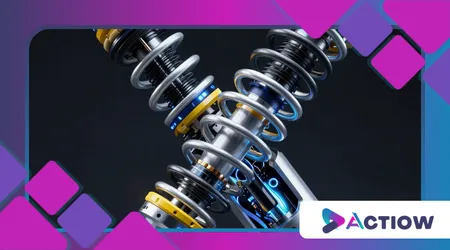
At its core, the hidden tech behind modern adaptive suspension is a closed-loop conversation between sensors, fluid, magnets, valves, and software that constantly rewrites how stiff or compliant each corner of the car wants to be.
Thirty years ago we were still arguing about passive springs versus basic hydraulics.
Now the conversation has moved underground—literally—into dampers that change personality millisecond by millisecond.
The shift started getting serious when General Motors put magnetorheological fluid into the 2002 Cadillac Seville STS.
That wasn’t just a feature; it was proof that electronics could finally out-think mechanical compromise.
Fast-forward to 2026 and you find versions of the same idea in family crossovers, track-focused coupes, and six-figure EVs.
The tech stopped being exotic and started being expected.
There’s a quiet social undercurrent here too. Roads haven’t gotten better—most places they’ve gotten worse.
Cities are denser, freight traffic heavier, potholes deeper.
Adaptive suspension quietly becomes infrastructure for mental health: less jarring means less fatigue, fewer micro-stresses piling up over a commute that already feels endless.
++ Maintaining Cars with Over-the-Air Updates: What You Still Need to Check
How Does It Actually Read and React to the Road in Real Time?
The system drinks data. Wheel-speed sensors, body-acceleration sensors, steering-angle sensors, even forward-looking cameras in the newest setups.
All that information hits an ECU that runs predictive algorithms—some of them machine-learning trained on millions of road miles.
The damper doesn’t wait for the bump; in advanced cases it’s already moving.
Take magnetorheological fluid again.
Apply a magnetic field and the iron particles inside align in milliseconds, turning thin oil into something almost solid.
Remove the field and it flows like water. That flip happens up to a thousand times a second.
Porsche’s latest hydraulic systems go further: they actively push fluid to lift a wheel before it lands in a pothole. It’s preemptive, almost anticipatory.
There’s something oddly poetic about it. The car is listening to the road the way a musician listens to silence before the next note.
Most drivers never think about that layer of awareness—they just feel “planted.” That’s the sleight of hand working.
Isn’t it strange how much trust we place in something we can’t see or hear?
++ Entry-Level EVs Reviewed for First-Time Buyers
What Are the Key Pieces That Make This System Tick?
Dampers are the muscle—either solenoid-valve units that meter oil through tiny orifices or MR units that use electromagnetism to thicken fluid.
Either way, they’re the part that turns electrical commands into mechanical resistance.
Sensors are the nervous system. You’ve got vertical accelerometers at each corner, lateral G sensors, ride-height lasers or ultrasonics, sometimes even wheel-position encoders.
The brain—an increasingly powerful ECU—sits in the middle, cross-referencing all of it against throttle position, brake pressure, steering rate, even GPS-derived road curvature in premium systems.
Then come the power actuators in fully active setups (Mercedes E-Active Body Control, for instance), which use hydraulic pumps to apply force independent of road input.
It’s overkill for most people, but when you experience it, the rest feels like half-measures.
++ How AI Learns Your Driving Style—and When It Gets It Wrong
Quick component snapshot:
| Component | Job | Seen in (examples) |
|---|---|---|
| MR / solenoid dampers | Variable resistance in real time | Corvette, Audi RS, BMW M |
| Body & wheel sensors | Feed raw motion data | Almost every premium adaptive system |
| Central ECU | Decision engine + predictive logic | Porsche, Mercedes, Tesla (newer) |
| Hydraulic actuators | Proactive force application | Mercedes ABC, Rolls-Royce, Nio ET9 |
Why Does It Leave Traditional Suspensions Feeling Dated?
Old-school suspensions force a single compromise: comfort or control. Adaptive refuses the binary.
It can be pillow-soft at 30 km/h over expansion joints, then stone-hard through a fast sweeper at 140.
That range used to require swapping springs and dampers between track days and grocery runs.
Safety numbers back the intuition. Independent testing (SAE papers and magazine instrumented comparisons) consistently shows 15–25 % better transient response in lane-change or emergency-avoidance maneuvers.
The car stays flatter, tires stay planted longer, driver inputs translate cleaner. In low-grip conditions the advantage grows.
It’s also quietly efficient. Less pitch and roll means less aerodynamic drag at speed, slightly better rolling resistance, marginal but measurable range gains in EVs.
The argument isn’t that passive is bad—it’s that adaptive stopped being a luxury tax and became rational engineering.
Where You Actually Feel the Difference on Real Roads
Spend a week delivering packages in a city with neglected side streets.
A Transit Custom with Ford’s adaptive dampers doesn’t erase the craters, but it keeps the van level instead of seesawing.
Fewer spills, less nausea for the driver, packages arrive intact. Small human wins.
Or picture carving mountain roads in a Cayman GTS. Mid-corner the system firms the outside dampers just enough to kill understeer before you feel it.
Then, cresting a rise, it softens instantly so the car doesn’t skip sideways. You’re faster and calmer at the same time.
Electric sedans carrying heavy battery packs feel the benefit hardest. Without adaptive logic, that extra 500–700 kg would make everything wallow.
Tesla’s newest implementations, BMW’s latest M adaptive setups, Lucid’s air + hydraulic combo—they all quietly cancel out the physics penalty of electrification.
The hidden tech behind modern adaptive suspension has quietly become one of the last places where analog driving joy and digital precision still shake hands.
Frequently Asked Questions
Common questions people actually ask when they start digging into the hidden tech behind modern adaptive suspension:
| Question | Straight answer |
|---|---|
| How long do these fancy dampers last? | Usually 80,000–140,000 km depending on roads. MR fluid lasts longer than early hydraulic systems. |
| Does it really save fuel or range? | Yes—typically 3–8 % better highway efficiency from reduced drag and optimized tire contact. |
| Can you retrofit it to an older car? | Aftermarket options exist (KW DDC, Bilstein B16 DCC), but full integration is tricky without factory electronics. |
| What happens in very hot or freezing weather? | Modern systems compensate via temperature sensors. Early MR units were fussier; current ones are robust. |
| Is the difference noticeable to normal drivers? | On bad roads or during quick maneuvers—yes. On smooth highways—mostly comfort, less fatigue. |
Want to go deeper?
Start with Car and Driver’s latest suspension tech roundup, BMW M’s technical breakdown of adaptive M suspension, and Top Gear’s explanation of active suspension’s path to mainstream.